The Uniform of the Hoch- und Deutschmeister Band
Attire of the Musicians:
The Hoch- und Deutschmeister traditional band has, since its reestablishment around 100 years ago, appeared in the parade uniform of the Imperial and Royal infantry regiments from around 1900. This includes trousers made of light blue cloth. In addition, there is a dark blue tunic with a standing collar, shoulder rolls, and cuffs in the regimental color sky blue, along with gold buttons. (At that time, there were both silver and gold buttons, 28 different regimental colors, and two different types of trousers for German or Hungarian regiments. This allowed for 112 different uniform combinations, and with knowledge of the color code, one could identify the regiment.)
On each side of the collar, stars and braids indicating rank are displayed, along with a lyre made of silver-colored metal as a symbol of a musician. Over the tunic, a wide belt made of black-lacquered leather—the so-called waist belt—is worn. It is fastened at the front center with a gold-colored brass buckle bearing a double-headed eagle.
The headgear is the so-called shako, a stiff cap made of black felt, edged with black-lacquered leather; the short visor and the top plate are also made of black-lacquered leather. At the front, the shako is adorned with a large double-headed eagle made of gold-colored brass. Above it is inserted a shako rosette, consisting of several circular metal ribs with a central black leather disc.
Attire of the Bandmaster:
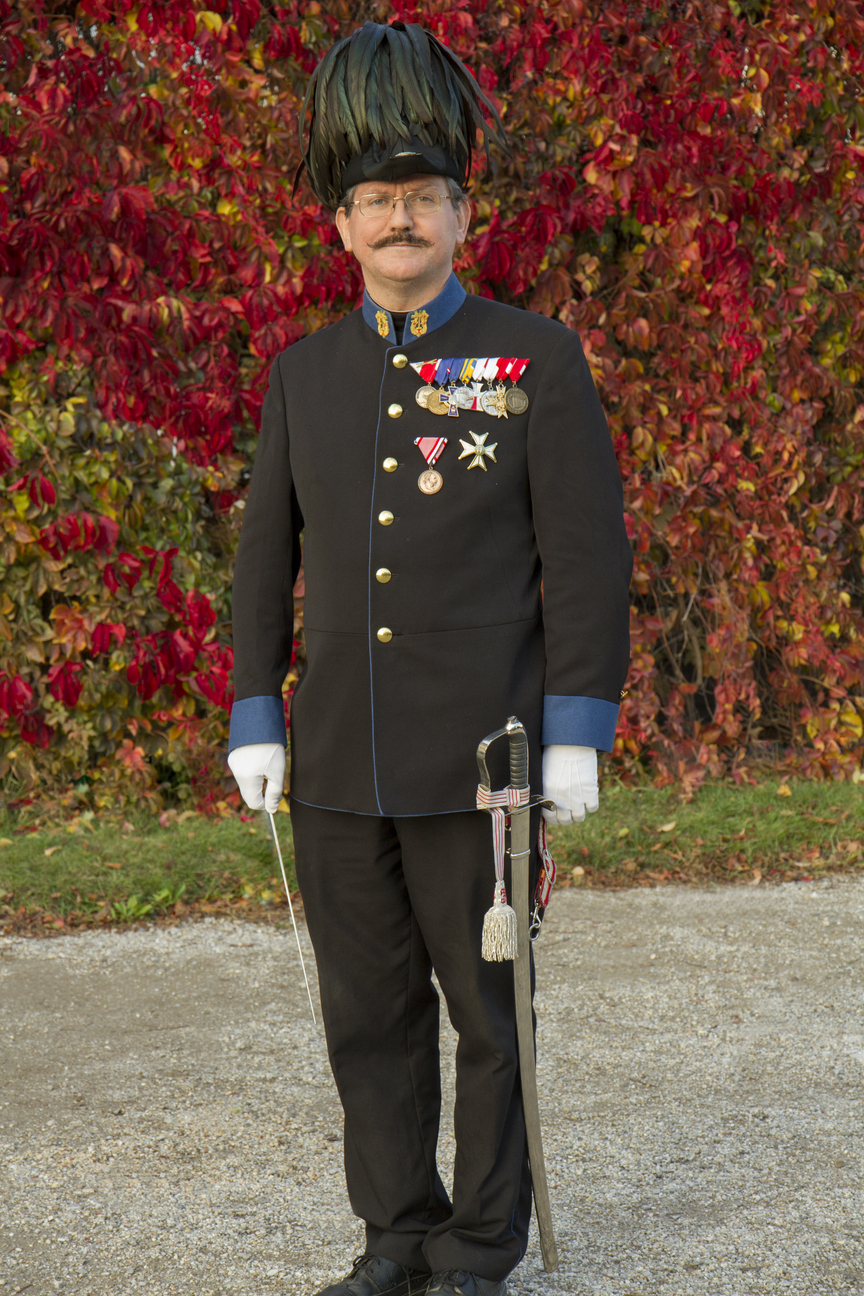
The bandmaster, who in the monarchy was a civilian under contract rather than a soldier, wears a uniform resembling that of an officer. This includes blue-gray trousers with piping in the regimental color. (The color “blue-gray” is nearly black and could today be described as anthracite.)
He also wears a black coat similar to that of the enlisted men, but piped in the regimental color and without shoulder rolls; the skirt folds are decorated with double-curved flaps. Instead of rank braids or stars, each side of the collar bears a gold-embroidered lyre crossed with a sword.
The straight-cut cap, about 10 to 15 cm high, is made of black cloth with a short visor of black-lacquered leather. At the front center is a cord loop with a rosette. For the bandmaster, these are not gold and black as for officers, but silver interwoven with red.
A second form of headgear for special occasions is the bicorne hat, turned up on both sides and decorated with braids and rosettes—again in silver rather than gold. Inserted at the top is a plume of black rooster feathers.
This is complemented by an officer’s saber approximately 80 cm long, in a nickel-plated scabbard, with a sword knot (portepee), also in silver and red rather than gold and black. The saber is attached on the left side to a belt worn underneath.
Author: Reinhold Nowotny