Horst Winter
Horst Winter was born on September 24, 1914, in Beuthen, Upper Silesia. At the age of seven, his family moved to Berlin, where he received his first music lessons and later studied music. By the age of 16, he was already supporting his family with his talent by leading his first dance orchestra. Since he primarily modeled his music on American swing, he was known in Berlin and Hamburg as "Germany's youngest jazz king."
During World War II, Horst Winter had little time or opportunity to perform. Nevertheless, he used the limited time available during leave and tours with the Wehrmacht to further develop his musical skills. He also recorded his first records during this period—not as an instrumentalist, but as a singer. He launched his recording career with the song "Ich liebe die Sonne, den Mond und die Sterne" (I Love the Sun, the Moon, and the Stars).
Du gehst durch all meine Träume
After his release from captivity as a prisoner of war, Horst Winter chose Austria as his new home. As early as December 1945, he performed at the Vienna Konzerthaus, and the following year he founded the "Vienna Dance Orchestra." With this orchestra, he gave numerous performances, introducing the Viennese to modern swing. It was during this time that he wrote one of his most famous songs, "A Little Bear with Big Ears." Following the Vienna Dance Orchestra, the "Horst Winter Dance Orchestra" was founded in 1950, building on his previous successes. During this period, the orchestra's home base was the café in the Volksgarten, when they weren't touring Germany or Switzerland. In addition to numerous recordings, Horst Winter also appeared in several revue films during the 1950s. He also collaborated with young Austrian jazz musicians such as Hans Koller and Joe Zawinul during this time.
Ein kleiner Bär mit großen Ohren
In the early 1960s, Horst Winter increasingly focused on solo performances. In 1960, as Harry Winter, he represented his adopted home of Austria at the Eurovision Song Contest with the song "Du hast mich so fand" (You Fascinate Me So), which Robert Stolz had composed especially for the occasion and also conducted at the competition. In 1961, he represented his adopted country with the song "Vogerl aus Wien" (Little Bird from Vienna) at the Monte Carlo International Chanson Festival and won first place. Numerous tours, appearances at the Bad Ischl Operetta Festival, and many television shows were his main activities during this time. And in 1973, he even stepped in for Frank Sinatra at a charity concert in Palm Springs.
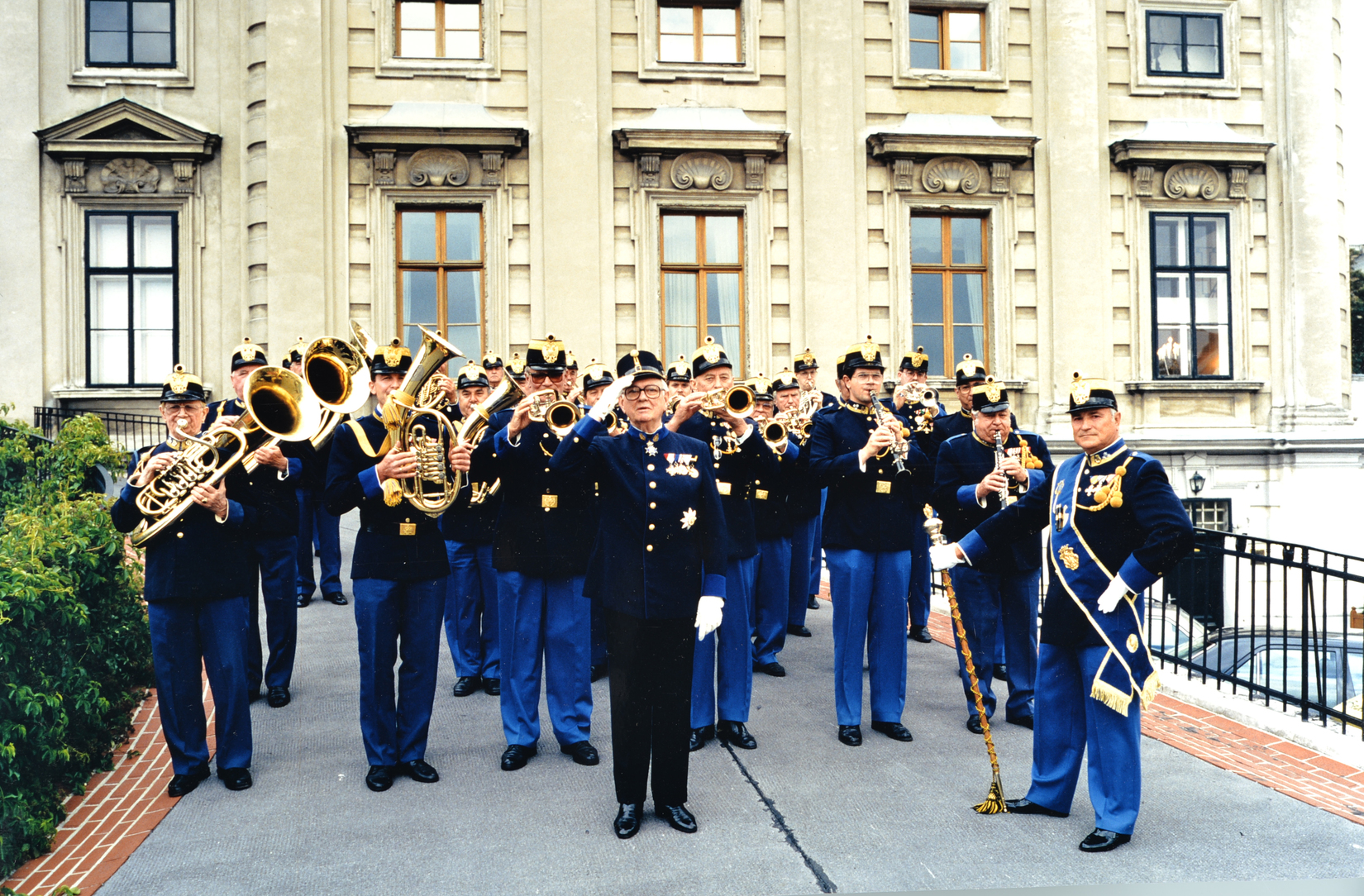
After the death of Julius Hermann, music manager Wilhelm Breitenfeld took over as chairman of the Original Hoch- und Deutschmeister and, after interim bandmaster and Hermann's music director Ferdinand Kastner decided he could no longer continue due to his age, was able to secure Professor Horst Winter as the new bandmaster a few months later.
Interview I zur Übernahme der Hoch- und Deutschmeisterkapelle
Interview II zur Übernahme der Hoch- und Deutschmeisterkapelle
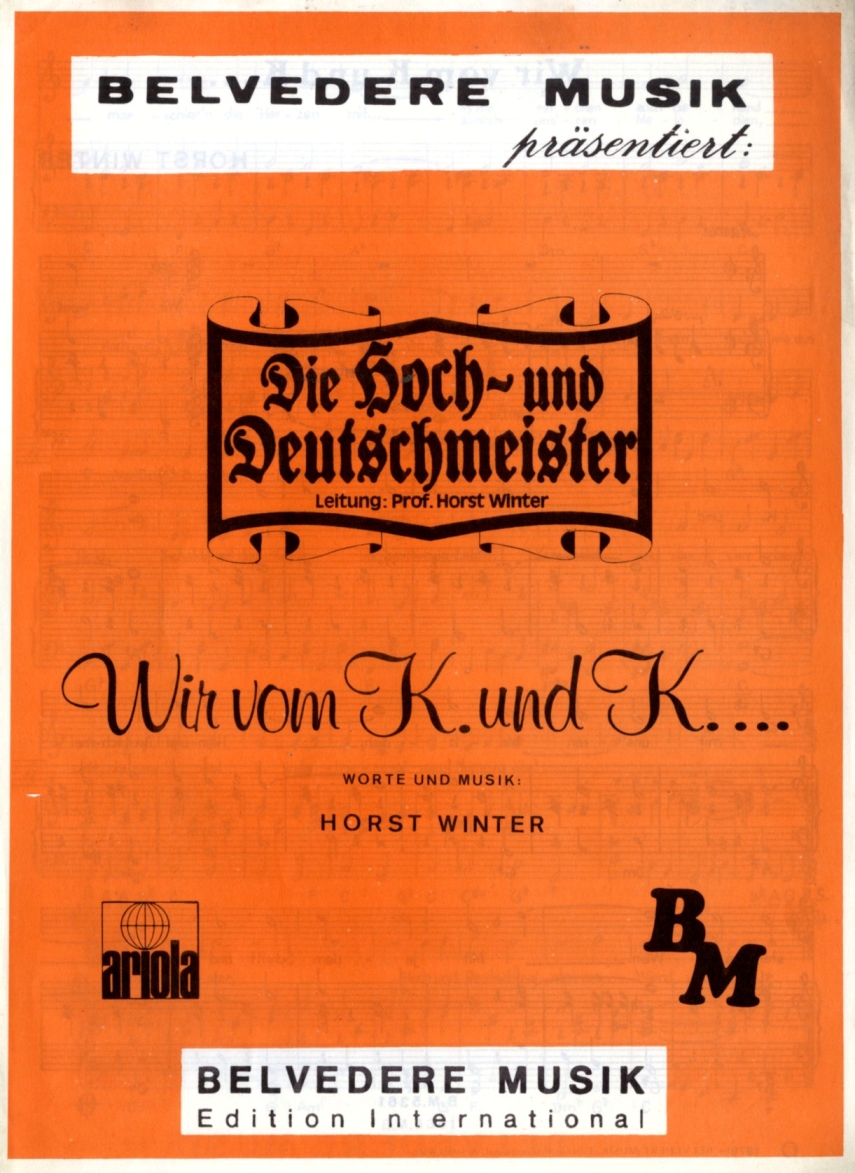
Although he came from a different musical background, he quickly gained access to this type of music and even composed his own piece, "Wir vom k.u.k., mir san wieda da".
He very quickly built upon the musical successes of his legendary predecessor. Under his direction, the Hoch- und Deutschmeister were engaged for a show celebrating Robert Stolz's 100th birthday, which was performed 58 times in Vienna and then ran for a month in Berlin.
The papal visits to Vienna in 1983 and 1988 also provided the orchestra with opportunities to showcase its talent to the world. In addition to these highlights, the Deutschmeister regularly toured Germany and Switzerland and appeared on numerous television shows, such as the "Peter Alexander Show" and "Musikantenstadl." Thus, the "Rucksack Berliner"—a term used for Silesians who had settled in Vienna after the war—became a true Viennese. Even the legendary Viennese singer "Schmied Hansl" attested to his exceptional interpretations of Viennese songs.
His tenure also saw numerous anniversaries, such as the 100th anniversary of the premiere of the Hoch- und Deutschmeister Regimental March on March 19, 1993, and the 250th anniversary of the Hoch- und Deutschmeister Band in 1991.
In 1998, due to health reasons, Horst Winter handed over the orchestra's conducting to Ottokar Drapal. He remained dedicated to music even in his later years and passed away in Vienna on December 3, 2001.
Horst Winter was awarded the title of "Professor" in 1976 and received the "Golden Badge of Honor." In 1994, he was awarded the "Golden Rathausmann" by the City of Vienna. Today, in addition to the numerous recordings of his interpretations, a memorial stone at the corner of Grinzingerstrasse and Heiligenstädterstrasse, as well as the "Horst Winter Promenade" in Vienna-Floridsdorf, serve as reminders of his life.
Further Information:
Stefan Schmidl/Monika Kornberger, Art. „Winter, Horst (Pseud. Harry Winter)“, in: Oesterreichisches Musiklexikon online, begr. von Rudolf Flotzinger, hg. von Barbara Boisits (letzte inhaltliche Änderung: 8.2.2011, abgerufen am 21.4.2026), https://dx.doi.org/10.1553/0x0001e714