Julius Herrmann
Born in Wiener Neustadt, Herrmann studied violin at the Vienna Conservatory and participated in the Hoch- und Deutschmeister's tour of Argentina in 1910. In 1931, he took over the Hoch- und Deutschmeister, a traditional band re-established by Wilhelm Wacek after the First World War, and led it for 46 years until his death in February 1977. He was not only the bandmaster, but also composed several of his own pieces, created arrangements, and compiled numerous medleys (a list of his works is provided below).
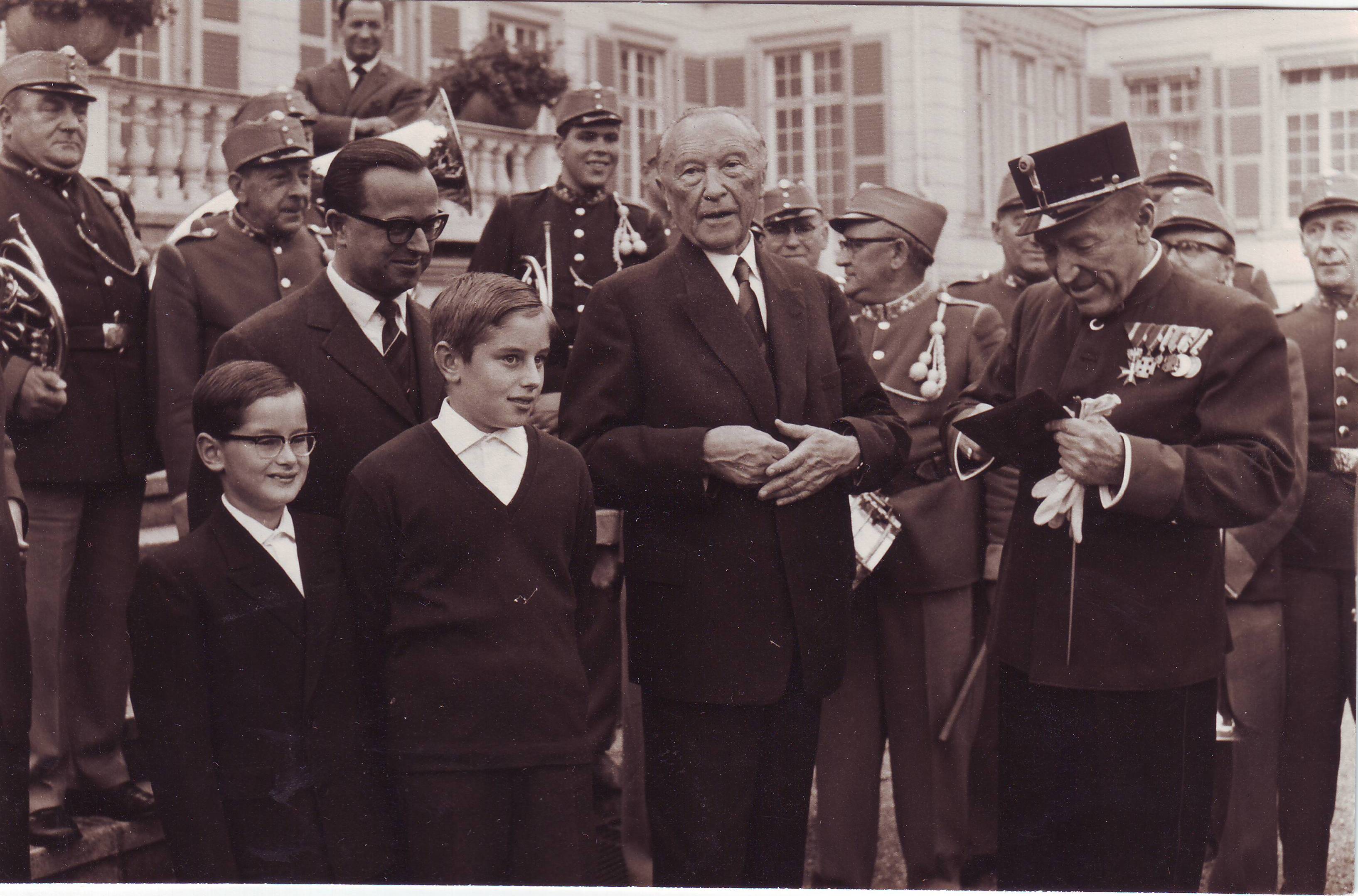
Thus, for decades after the end of the Austro-Hungarian Empire, he ensured that the Hoch- und Deutschmeister remained what they had been during the monarchy: an outstanding band! Countless tours, a large number of recordings, and a long list of honors (including the title of professor) testify to his tireless work as an ambassador of Austrian, and especially Viennese, music both at home and abroad. It was no coincidence that newspapers quoted German Chancellor Konrad Adenauer in this context:
"The Hoch- und Deutschmeister are probably the last official relic of the old monarchy – even in the Kreisky Republic, they perform for their audiences in the smart, blue Austro-Hungarian uniforms, their chests adorned with medals. Incidentally, Chancellor Adenauer commented on this when the Deutschmeister played for him in Vienna shortly before the legendary Khrushchev-Kennedy meeting: 'What do you think Khrushchev's reaction will be when he sees this?'"
Aus den 1930ern: Der Traum eines österreichischen Reservisten - 1. Teil
Der Traum eines österreichischen Reservisten - 2. Teil
Der Traum eines österreichischen Reservisten - 3. Teil
Der Traum eines österreichischen Reservisten - 4.Teil
Further information: Uwe Harten, Art. „Herrmann, Julius“, in: Oesterreichisches Musiklexikon online, begr. von Rudolf Flotzinger, hg. von Barbara Boisits (letzte inhaltliche Änderung: 30.1.2023, abgerufen am 21.4.2026), https://dx.doi.org/10.1553/0x0001d13f
The deutschmeister band in the early 1960s with the German Chancellor Dr. Konrad Adenauer: