Wilhelm August Jurek / Dominik Ertl / Johann Müller / Anton Klemm / Joseph Dubez
About other famous bandmasters or musicians of the Hoch- und Deutschmeister band, or those associated with it, written by Mag. Raimund Sulz and Reinhold Nowotny. Special thanks to our honorary member Prof. Walter Schwanzer for providing numerous scans, and to Dr. Friedrich Anzenberger for his many years of research published online.
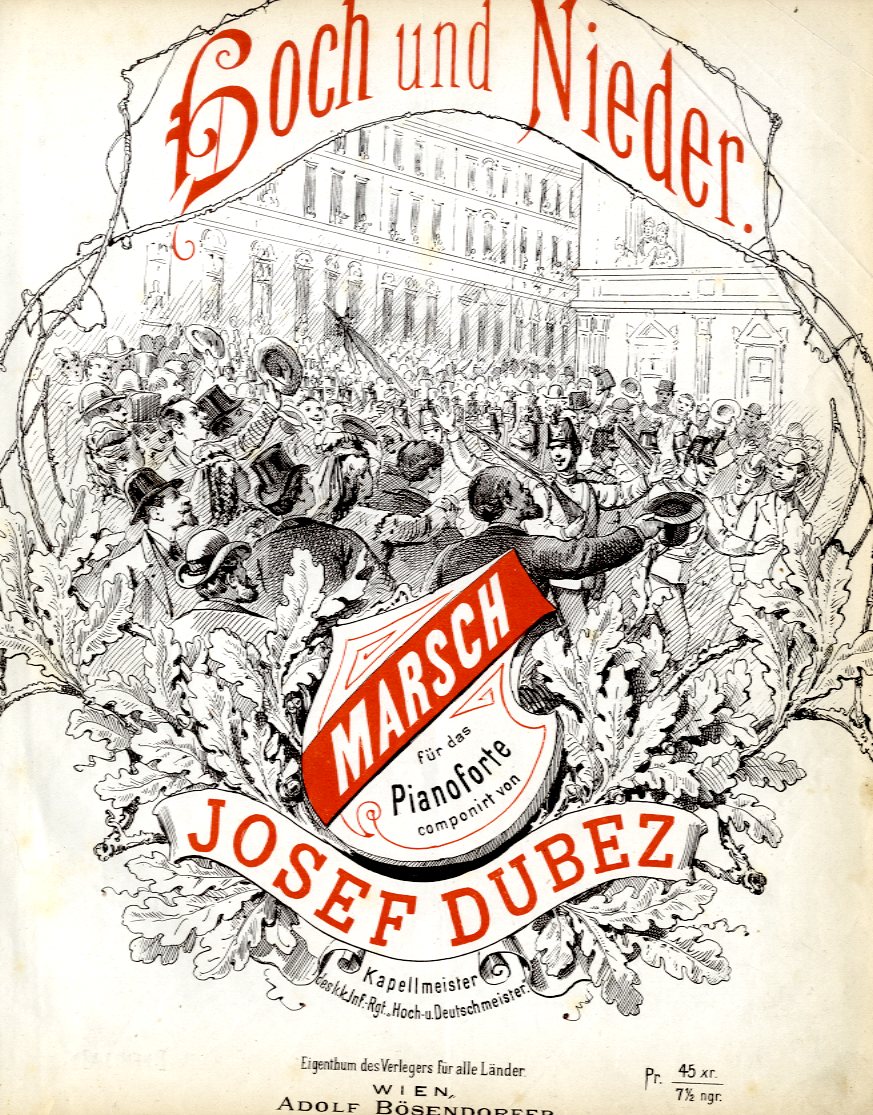
Photo: Scan of the title page of the “Hoch- und Nieder-Marsch” by Joseph Dubez (private collection – honorary member Prof. Walter Schwanzer)
Wilhelm August Jurek – the famous composer of the “Deutschmeister Regimental March”
(April 29, 1870 – April 9, 1934)
Wilhelm August Jurek was—contrary to what is often claimed—never a musician, regimental drummer, or bandmaster with the Imperial and Royal Deutschmeister regiment. Instead, he completed his three years of military service as a company assistant and composed the march that later became famous on the occasion of the mid-service celebration in 1893,[1] having joined the regiment on October 1, 1891.
One Saturday, while stamping numerous permits,
“[…] in the steady rhythm of his monotonous work, a melody playfully came to him, which helped pass the time and had the same text as the stamp he was applying hundreds of times. Humming, he retained the melody until he could go home; once there, he wrote a few verses and the music. And thus the song was born that today is known and sung by millions.
A friend to whom he sang it declared the whole thing a disaster. Nevertheless, he sought a publisher and found one in Otto Maaß, who, however, demanded that Jurek contribute 30 of the 60 gulden printing costs. The diligent corporal paid, and now held his composition in print.
Soon afterward, during the spring inspection by Emperor Franz Joseph in the Vienna Prater, the regiment excelled. Field exercises, drills, and parade all went well, and the Emperor praised the Deutschmeister highly. Unsurprisingly, enthusiasm spread throughout the regiment. Beer barrels rolled into every company, and at the height of the celebration, Jurek gathered the courage to ask his company commander, Captain von Stein, to introduce him to the regimental commander, Colonel Werner, so that he might dedicate his composition to the regiment.
The meeting was arranged, and since bandmaster Ziehrer was at the World’s Fair in Chicago at the time, his deputy and the regimental drummer Neidhart were summoned. The colonel handed them the march and ordered them to orchestrate it and perform it at the next concert in the Volksgarten. Even before that, Jurek and Wilhelm Auerböck performed the march at a comrades’ evening at the St. Veit Casino, and both times it was so successful that by the second and third repetition, the audience was already singing along.
At first, the members of the regimental band were skeptical of the young composer, as they were accustomed to Ziehrer’s well-founded musicianship, while Jurek had no formal musical training. Shortly thereafter, however, the regiment moved to the Bruck camp, where Archduke Wilhelm was present. When the march was played again, he liked it so much that he demanded it be repeated three times, thus breaking the ice between Jurek and the band. The march was then played more and more often, taken up by other military bands, civilian orchestras, and salon ensembles, and within a short time became famous throughout Austria.”[2]
[1] Anzenberger, Symposiumsbericht, 60f.
[2] Vierzig Jahre Deutschmeistermarsch. In: Neues Wiener Tagblatt (Tages-Ausgabe), Jg. 67, Nr. 329 (28. November 1933) 7, online unter: https://anno.onb.ac.at/cgi-content/anno?aid=nwg&datum=19331128&seite=7 (19.12.2024).
Dominik Ertl – regimental drummer and composer of the “Hoch- und Deutschmeister March”
(April 12, 1857 – February 4, 1911)
Dominik Ertl was born on April 12, 1857, in Vienna, the son of a grocer. He received violin lessons at a young age and later studied at the Conservatory of the Gesellschaft der Musikfreunde in Vienna.
Around 1875, he received his first engagement at Danzer’s Orpheum in Vienna, where he worked not only as a bandmaster but also composed numerous works.
In 1877, Ertl entered military service with Infantry Regiment No. 4 “Hoch- und Deutschmeister,” serving as a solo violinist under bandmaster Josef Dubez. On October 6, 1880, he completed the piano draft of his Hoch- und Deutschmeister March, which became his most successful composition. The orchestral score for strings is dated July 8, 1885. Both manuscripts are preserved in his estate at the Vienna Library. Printed editions were announced in September 1885 by the publisher Gustav Levy in Vienna.[1]
He also composed the potpourri “An Evening with the Deutschmeister.” Bandmaster Dubez assembled a successful Schrammel quintet from Deutschmeister soloists, including J. Hellmesberger Jr., Josef Bayer, Ertl, and the Dietrich brothers.[2]
After his military service, he continued working at Danzer’s Orpheum until at least 1891. He later founded his own orchestra, toured Europe (including Riga in 1891), and performed in various Viennese entertainment venues such as Circus Renz, Sperl, Ronacher, and “Venice in Vienna.” From 1895 to 1898, he served as choirmaster of the Rossau Male Choral Society, and in 1898 he was appointed to the Central Theatre in Dresden.[3]
[1] Friedrich Anzenberger, Zum 110. Geburtstag von Dominik Ertl, Komponist des "Hoch- und Deutschmeister-Marsches". In: anzenberger.info, hg. von Dr. Friedrich und Elisabeth Anzenberger, letzte Änderung am 20. Februar 2021, online unter: https://www.anzenberger.info/ertl/ (19.12.2024).
[2] Siegfried Lang, Art. „Dominik Ertl“. In: Lexikon österreichischer U-Musik-Komponisten im 20. Jahrhundert (Wien 1986), 38.
[3] Elisabeth Th. Hilscher/Monika Kornberger, Art. „Ertl, Dominik“, in: Oesterreichisches Musiklexikon online, begr. von Rudolf Flotzinger, hg. von Barbara Boisits (letzte inhaltliche Änderung: 18.4.2023, abgerufen am 19.12.2024), https://dx.doi.org/10.1553/0x0001ccd5
Joseph Dubez – longest-serving bandmaster of the Hoch- und Deutschmeister
(October 22, 1824 – May 22, 1900)
Joseph Dubez was a bandmaster and composer who studied violin at the Vienna Conservatory and played in Joseph Lanner’s orchestra, even owning Lanner’s last violin.
From 1848 to 1860, he served as bandmaster of Infantry Regiment No. 4 in various garrisons, mostly near Budapest. He married Theresia Kovatsits in Budapest in 1859. After leaving the military in 1860, he briefly managed a venue called “Bierhalle” in Budapest and, together with Béla Kéler, founded an orchestra in 1861.
When the regiment returned to Budapest in 1863, he resumed his position as bandmaster. His daughters Gisela (1864) and Barbara (1866) were born in the Üllöer barracks. He later served in garrisons such as Völkermarkt, Ragusa, Graz, and Tulln.
In 1877/78, he participated with the regimental band in the first Hofoper soirées—the predecessors of the Vienna Opera Ball. In 1879, due to the relocation of IR 4, he transferred to IR 21 in Graz and Prague. From 1882 until his retirement in 1894, he served as bandmaster of IR 32 in Budapest.
He composed numerous dance pieces, especially marches, polkas, and waltzes, as well as potpourris and arrangements of classical music, many of which were published by Bosworth.
Source: Reinhold Nowotny
Johann Müller – musician under Ziehrer and later military bandmaster
(May 10, 1856 – October 30, 1924)
Johann Müller, born in Maustrenk (Lower Austria), played with the Deutschmeister from 1876 to 1890, with a short interruption.[1] He rose to the rank of sergeant and became deputy bandmaster.
Carl Michael Ziehrer included Müller’s compositions in his concert programs, frequently performing his potpourri “Vienna, As It Weeps and Laughs.” From 1885 to 1887, Müller temporarily left the Deutschmeister to play with the band of Infantry Regiment No. 89 under Karl R. Sebor.[2]
He later became military bandmaster for Infantry Regiments No. 46, 82, and finally No. 84.[3] After his military career, he led a highly successful civilian orchestra, which even performed at the Paris World’s Fair.[4]
In 1903, Müller succeeded Ziehrer in taking over his musicians for his own private orchestra:
“As is known, bandmaster C. M. Ziehrer has withdrawn from the concert academies he had held for years in the Ronacher ballroom. Bandmaster Johann Müller will take his place and, as he assures, will strive to maintain them at the same high level […] He has taken over the musicians of Ziehrer’s former orchestra.”[6]
[1] Taufeintrag „Johann Müller“. In: Taufbuch (Signatur 01 – 02; 1. Januar 1834 – 31. Dezember 1859) der r.k. Pfarre Maustrenk, 2225 Zistersdorf, Erzdiözese Wien auf Seite 149 - Taufe 6, online unter: http://data.matricula-online.eu/de/oesterreich/wien/maustrenk/01-02/?pg=152 (19.12.2024).
[2] Friedrich Anzenberger, Johann Müller: zum 150. Geburtstag. In: Österreichische Blasmusik, Fach- und Verbandszeitschrift des Österreichischen Blasmusikverbandes (ÖBZ) 54, H. 9 (Oktober 2006) 21.
[3] Friedrich Anzenberger, Kurzgeschichte der „84er“-Kapelle und ihrer Kapellmeister. In: Walter Schwanzer Musikverlage, hg. von Walter Schwanzer, online unter: https://www.schwanzer.at/84er-regimentskapelle/geschichte/ (19.12.2024).
[4] Capellmeister Johann Müller. In: Deutsches Volksblatt, Jg. 12, Nr. 4273 (24. November 1900) 8, online unter: http://anno.onb.ac.at/cgi-content/anno?aid=dvb&datum=19001124&seite=8 (19.12.2024).
[5] Konzertakademie im Ballsaale Ronacher. In: Ostdeutsche Rundschau, Jg. 14, Nr. 278 (11. Oktober 1903) 8, online unter: http://anno.onb.ac.at/cgi-content/anno?aid=odr&datum=19031011&seite=8 (19.12.2024).
[6] Friedrich Anzenberger, 125 Jahre "Weana sa ma" - Marsch von Johann Müller. In: anzenberger.info, hg. von Dr. Friedrich und Elisabeth Anzenberger, letzte Änderung am 30. Mai 2021, online unter: https://www.anzenberger.info/johannmueller/ (19.12.2024).
Anton Klemm – military bandmaster of the Hoch- und Deutschmeister and predecessor of Ziehrer
(January 9, 1844 – February 20, 1920)
Anton Klemm succeeded Joseph Dubez as bandmaster of the Hoch- und Deutschmeister from 1879 to the end of December 1883. He had joined the regiment in 1871 and was promoted to sergeant in 1873.
“Anton Klemm was born 175 years ago on January 9, 1844, in Biblin, Bohemia. He served in various infantry regiments from 1860 before joining the Hoch- und Deutschmeister in 1871. On January 1, 1873, he was promoted to sergeant. In 1879, he became bandmaster of Infantry Regiment No. 4 and was stationed in Cattaro, Innsbruck, and Vienna. According to his personnel records, he was an ‘excellent clarinetist and composer’ who achieved ‘very good results’ as a bandmaster. Nevertheless, he was dismissed by the regimental command at the end of 1883, for reasons that are not recorded in surviving documents. From 1884, he served as bandmaster of Infantry Regiment No. 21 until his retirement in 1898 due to severe deterioration of eyesight. He died on February 8, 1920, in Kuttenberg, Bohemia (now Kutná Hora, Czech Republic).”[1]
[1] Friedrich Anzenberger, Anton Klemm, Kapellmeister der Hoch- und Deutschmeister - zum 175. Geburtstag. In: anzenberger.info, hg. von Dr. Friedrich und Elisabeth Anzenberger, letzte Änderung am 31. Oktober 2019, online unter: https://www.anzenberger.info/2019/10/28/anton-klemm-kapellmeister-der-hoch-und-deutschmeister-zum-175-geburtstag/ (19.12.2024).